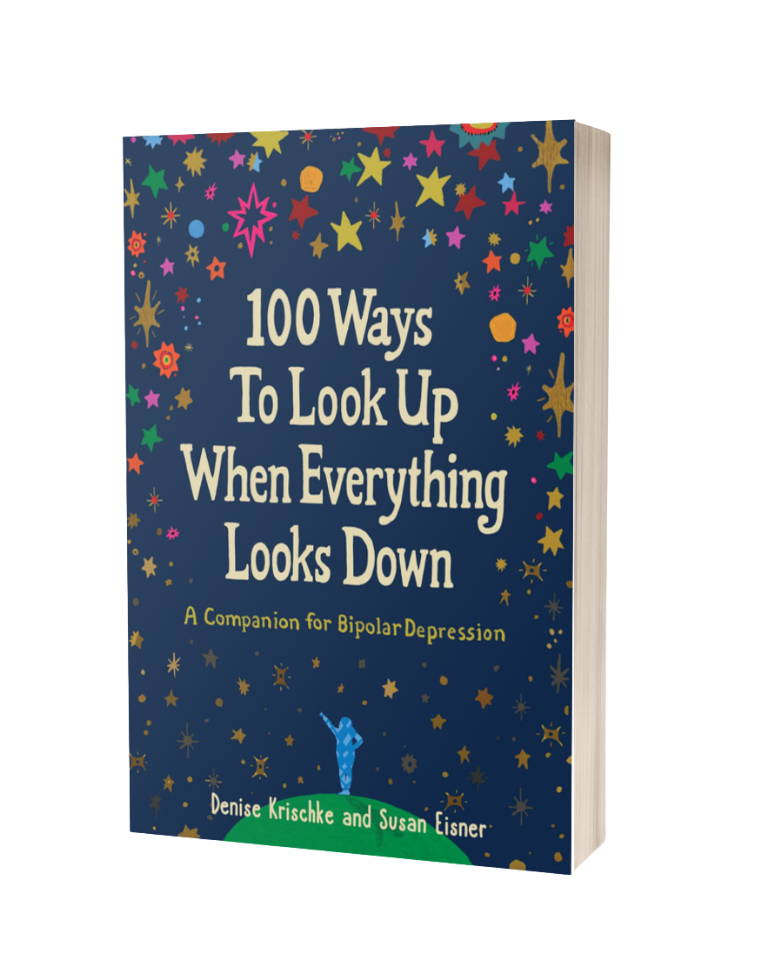
For those who know what mental illness looks like close-up, an easily digestible self-help book of 100 mental health wellness tips born from the authors’ lived experiences managing bipolar depression.
100 pages. 100 ways to feel better.

-
![Denise Krishke]()
Denise Krischke
CO-AUTHOR
Denise Krischke, LMSW, holds a bachelor’s degree in public relations and social sciences and communications from USC and a master’s degree in social work from Boston University. With seven years of experience as a mental health peer support specialist, she also spent a decade facilitating support groups for a Depression and Bipolar Support Alliance affiliate chapter she founded in Ventura, CA. A former psychotherapist intern, she is now a nephrology social worker thriving on the bipolarity spectrum with faith, family, friends, movies, and music. She currently lives in Las Vegas, Nevada, and is working on a memoir.
-
![Susan Eisner]()
Susan Eisner
CO-AUTHOR
Susan Eisner’s poetry, prose, and short stories have appeared in The Stockholm Review of Literature, Outburst!, and The Malpais Review. She holds a Bachelor of Arts in cinema production from USC. Her work in the film and television industry have earned her Emmy and Golden Reel nominations, and inclusion in The American Film Institute’s “100 Years of Movies.” She retired from filmmaking to raise children and build spaceships. With her kids now grown, Susan writes and plays the drums. She lives in Fairfield County, Connecticut.